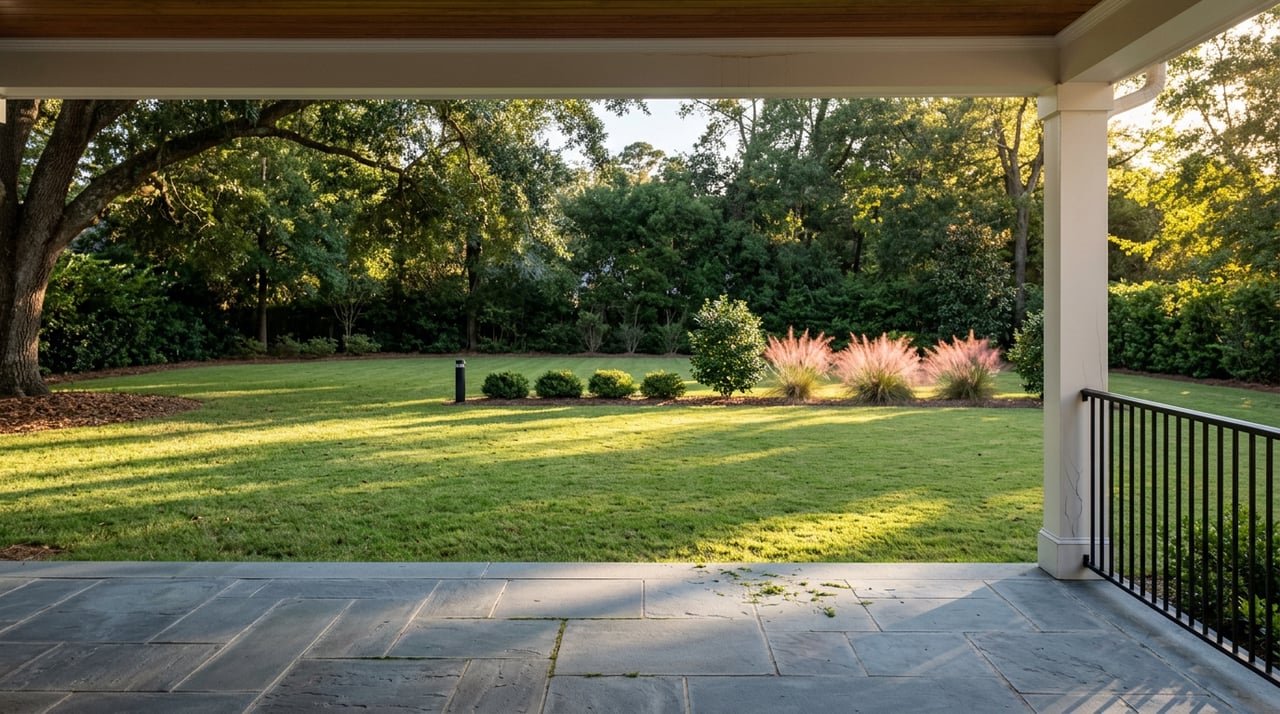
Pull up to Eastwood Road on any evening this August and the stretch just outside Landfall's gates looks different than it did even three years ago. Cars are angling for parking at Kipos Hellenic Cuisine, the new coastal concept from chef Giorgios Bakatsias. A few minutes down the block, Origins Food and Drink is already at capacity on a Tuesday. Cross through the gate itself and the pace changes entirely: golf carts moving at their usual unhurried speed, staff at the Country Club of Landfall's Nicklaus Clubhouse quietly setting up for a show that predates most of the newer homes in the community.
That contrast is worth more than a passing glance, because it points to something about this neighborhood that a real estate listing won't tell you. Landfall's reputation runs on its amenities: 45 holes of golf laid out by Pete Dye and Jack Nicklaus, tennis and pickleball at the Cliff Drysdale Sports Center, a location directly on the Intracoastal Waterway across from Wrightsville Beach. All of that is real and dates back to the community's founding in 1987. But the thing that has actually held Landfall together, year after year, isn't anything a developer built. It's something residents started themselves, eight years after the gates went up, and this month it posted numbers bigger than at any point in its history.
The 27th Art Show Is Not Just an Art Show
This year marks the 27th Annual Landfall Foundation Art Show and Sale, with a preview party on August 24 and the public show running August 25 through 27 at the Nicklaus Clubhouse. More than 225 artists will have work on display, spanning oil, watercolor, sculpture, and ceramics, all of it for sale and all of it judged before the doors open to the public.
Twenty-seven years is long enough that the arithmetic starts to say something on its own. Around the time of the 24th show, the Foundation's running total stood at $6.8 million donated to Wilmington-area nonprofits and schools since its founding in 1995. Today that figure has passed $8.6 million.
$6.8 million around 2023. More than $8.6 million by 2026.
That's roughly $1.8 million raised in three years, a pace that outstrips what the Foundation's first two and a half decades would suggest on their own. A tradition that started as a neighborhood art sale has turned into one of the steadier sources of nonprofit funding in this part of the county, and it's still accelerating rather than leveling off.
Where the Money Actually Lands
None of that total comes from a corporate sponsor or an endowment sitting untouched. It comes from three events residents organize themselves each year: the spring Gala, the August Art Show, and the December Holiday Marketplace. Last October, the Foundation's most recent full distribution split $685,000 among 67 local nonprofits and schools across New Hanover, Brunswick, and Pender counties, with roughly $243,725 going to health and welfare programs, $180,303 to education initiatives, and $107,445 to arts organizations. If you've ever bought a painting off the Nicklaus Clubhouse wall in August or picked up a gift at the Marketplace in December, you had a hand in that distribution.
It's a detail easy to miss if you think of Landfall purely in terms of golf and gates. The community's most durable civic institution isn't a facility. It's a fundraising calendar that residents have kept running, and growing, for nearly three decades.
What Changed on Eastwood While the Art Show Was Getting Bigger
Just outside those same gates, Eastwood Road has filled in at a pace that roughly mirrors the Foundation's growth curve. Kipos Hellenic Cuisine opened at 1900 Eastwood Road as the coastal-focused sibling to Bakatsias's long-running Kipos Greek Taverna in Chapel Hill. The Wilmington menu leans into that geography on purpose. More than 80 percent of the seafood is sourced locally, the crudo rotates with whatever's fresh, and the space is built around a covered garden patio that gives the whole thing a brighter, more open feel than a typical taverna.
A short drive down the same corridor at Autumn Hall, Origins Food and Drink has already done the work of becoming a fixture, carrying a 4.7-star rating from 60 OpenTable diners. The two restaurants sit close enough together that a resident can be at Origins for a contemporary American dinner one night and at Kipos for coastal Greek the next, without leaving a two-mile stretch of road. That kind of density on Eastwood didn't exist five years ago, and it's the sort of change that never makes a headline but quietly resets what a weeknight looks like for the people who live nearby.
The Rest of the Week Doesn't Slow Down Either
None of this replaces what already worked here. Howe Creek still winds along the community's edge on its way to the Intracoastal, and homesites throughout Landfall sit among the lakes, ponds, and creeks the developer built the community around. Late August is one of the better stretches for getting out on that water: mornings have cooled a few degrees even though the water hasn't, which makes for calmer paddling before the golf carts start moving for the day. The Cliff Drysdale Sports Center keeps its tennis and pickleball courts full well into the evening, and the club's 45 holes across the Pete Dye and Nicklaus layouts remain the reason a good share of residents chose this community in the first place.
What's different is that none of those amenities require leaving the immediate area anymore to round out an evening. The Art Show gives residents a reason to walk into the Nicklaus Clubhouse for something other than a tee time. Kipos and Origins give them a reason to stay on Eastwood instead of driving downtown for a decent meal. Neither change is dramatic by itself. Together they describe a neighborhood that has become more self-sufficient over time, not because it was designed that way back in 1987, but because residents and the businesses around them kept building things worth walking or driving five minutes to reach.
The Takeaway for Anyone Already Living Here
The golf courses and the gate get most of the attention when people describe Landfall from the outside. But if you already live inside those gates, the more telling story this month is smaller: a resident-run foundation that has quietly passed $8.6 million in local giving since 1995, arriving in the same season that the road just outside the gate has more worth eating at than it did a few years ago. That's not really a story about amenities. It's a story about a place that keeps reinvesting in itself, in ways that show up on a clubhouse wall in late August and on a restaurant patio on Eastwood the rest of the year.
If you're weighing a move within Landfall, curious what a home like yours might be worth in today's market, or just want to talk through the neighborhood with someone who spends time in it, Happy Clark is happy to have that conversation, no pressure attached. You can also browse the Landfall neighborhood guide for a closer look at what living here actually involves.
